Mastering the Mid-Term: A Definitive Guide to Swing Trading
Capturing market momentum through structured technical analysis and strict risk management.
Swing trading is the art of capturing distinct price 'swings' within a broader market trend. Unlike day trading, which requires constant vigilance and closes all positions before the final bell, or long-term investing, which demands multi-year patience, swing trading occupies the profitable middle ground. Positions typically last from several days to several weeks. This methodology aims to profit from the natural ebb and flow of asset prices, capitalizing on price volatility while bypassing the noise of intraday fluctuations.
The Geometry of the Swing
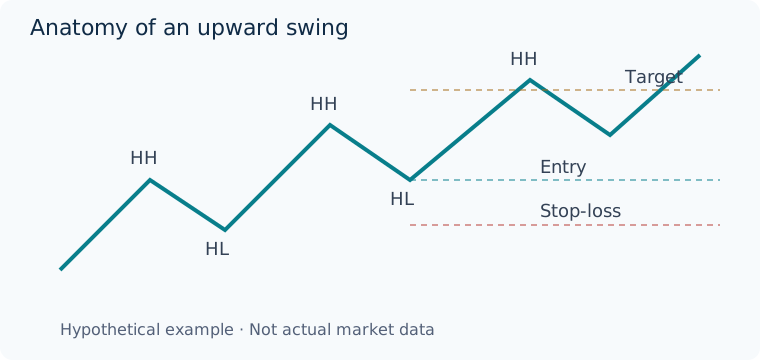
The foundation of swing trading rests on identifying the market's primary direction. It works best in markets that are clearly trending up or down, rather than moving sideways (ranging). In a classical uptrend, price action forms a series of higher highs (HH) and higher lows (HL). The swing trader's objective is simple but powerful: buy (go long) at a temporary low (a HL swing point) and sell when the price reaches a temporary peak (a HH swing point). Conversely, in a downtrend characterized by lower highs (LH) and lower lows (LL), the strategy involves short-selling at the LH and covering the position at the LL. Success requires recognizing these turning points just as they materialize.
Essential Technical Tools
Swing traders are, first and foremost, technical analysts. While they do not ignore fundamental catalysts, their primary conviction comes from the chart. Their toolbox is sophisticated, yet elegant. Essential instruments include:
- Moving Averages (MAs): The 50-day and 200-day simple moving averages (SMAs) are critical indicators. A smooth 50-day SMA sloping upward helps confirm an uptrend. Many traders initiate long positions when the price pulls back and "bounces" precisely off the 50-day line, treating it as dynamic support.
- Volume Analysis: Price movement alone can be misleading. Volume validates the move. When a stock breaks out from a consolidation pattern or bounces off a moving average, a corresponding spike in relative volume confirms that institutional conviction—and hence sustainable momentum—is behind the 'swing.'
Rigorous Risk Management
This is the non-negotiable component. While swing trading offers substantial profit potential, a string of unmanaged losses will erase a portfolio. The difference between a successful trader and a professional gambler is risk control. A core concept is the Risk-to-Reward Ratio (R:R). Swing traders aim for a ratio of at least 1:2 or 1:3. This means that for every dollar they risk on a potential loss, they expect a profit potential of two or three dollars.
For instance, if a trade is entered with a predetermined stop-loss set $2.00 below the entry point, the first price target (exit point) must be $4.00 or $6.00 above the entry. This discipline ensures that a trader can be wrong 50% of the time and still be consistently profitable.
The 1% Rule: No single swing trade should ever risk more than 1% to 2% of total account equity. Calculate your position size strictly based on the distance to your logical stop-loss order.
Executing the Strategy
Successful swing trading demands systematic patience. The trader waits for three aligned confirmations before acting: First, a clear market trend (e.g., price is above the 50-day SMA). Second, a recognized technical pattern formation (e.g., a "bull flag" consolidation, or a perfect test of established support). Third, an explosive entry signal, often in the form of specific candlestick patterns (like a bullish "hammer") and confirmed by rising volume.
When all these factors align, the trigger is pulled, a precise stop-loss is placed immediately, and the trader patiently monitors the daily close, ignoring minor noise. Swing trading is not about catching every wiggle; it is about capturing the meat of the move. By adhering to structure, utilizing volume, and enforcing strict discipline, swing traders navigate volatility, turning market momentum into consistent wealth.