Candlestick Patterns
Three White Soldiers and Three Black Crows: A Sustained Push
The three white soldiers and three black crows are three-candle patterns that describe a sustained push in one direction. The three white soldiers pattern consists of three consecutive green candles, each closing higher than the previous; the three black crows pattern consists of three consecutive red candles, each closing lower than the previous.
The patterns are trend descriptions, not reversal signals. They describe a market where one side is in control for three consecutive sessions, which is consistent with a trend rather than a reversal.
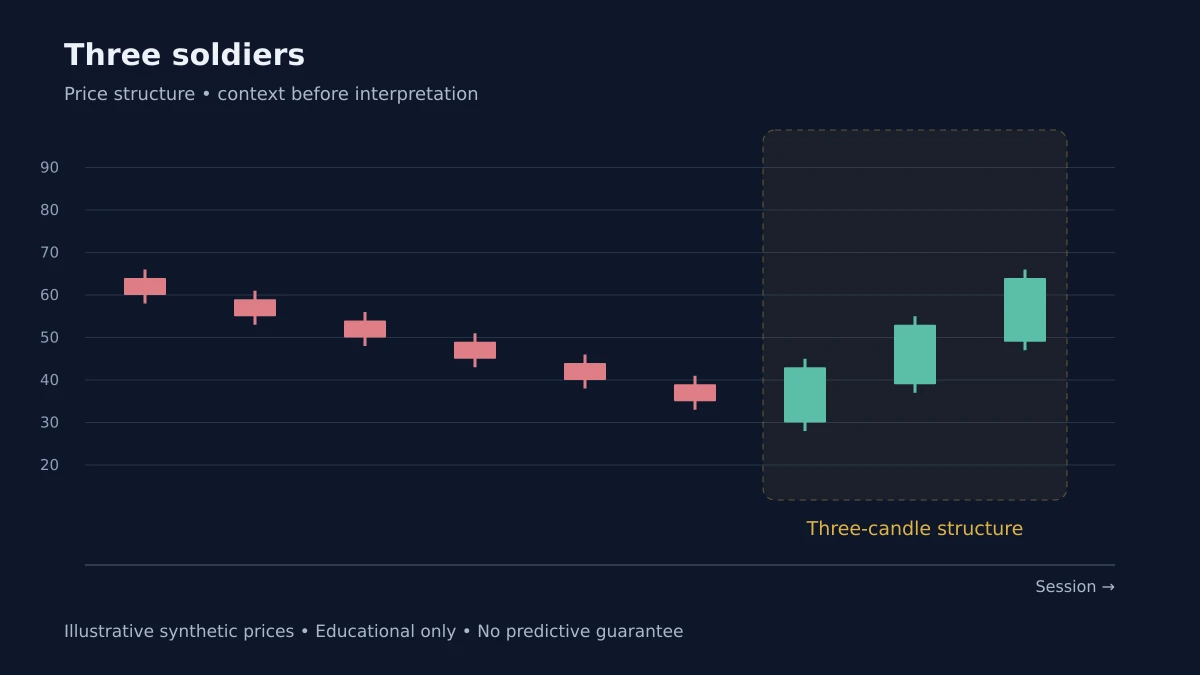
The Three White Soldiers
The three white soldiers pattern appears at the bottom of a downtrend or after a consolidation. The three green candles each open within the previous candle's body and close near their highs. The pattern describes a sustained push by buyers, with each session building on the previous one.
The pattern is more meaningful when the candles are of similar size and when the third candle closes near its high, which suggests the buyers are still in control at the end of the session.
The Three Black Crows
The three black crows pattern is the mirror image. The three red candles each open within the previous candle's body and close near their lows. The pattern describes a sustained push by sellers.
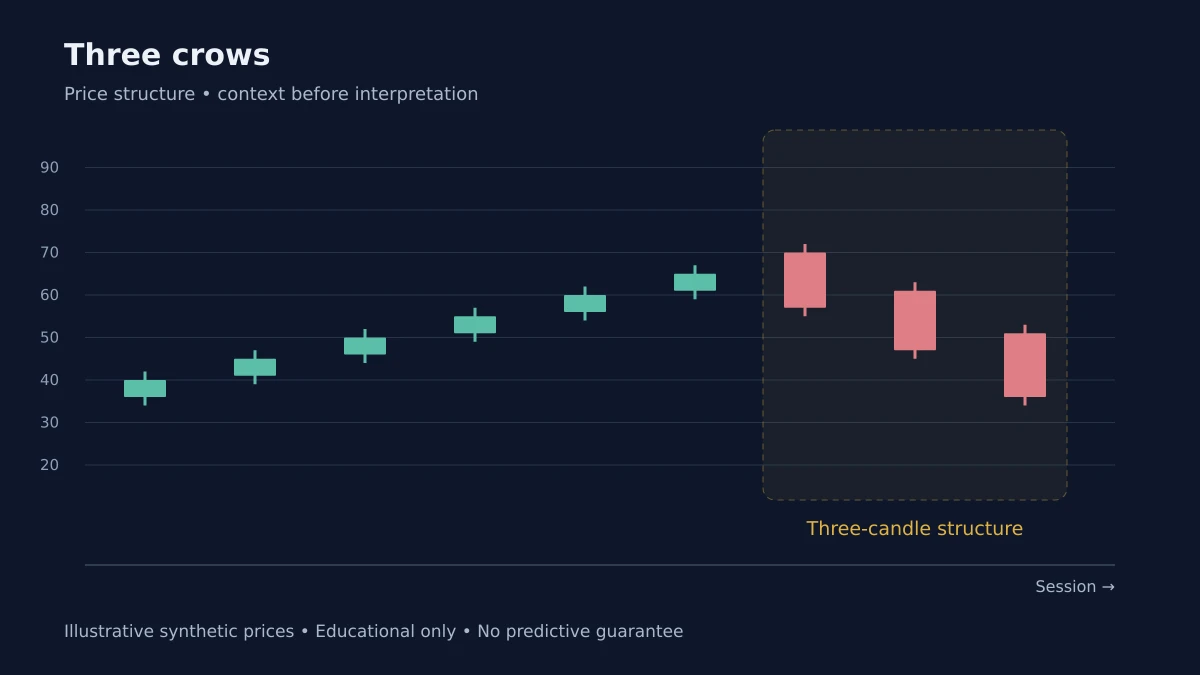
The Reversal Reading
In classical candlestick theory, the three white soldiers pattern is sometimes read as a reversal at the bottom of a downtrend, and the three black crows pattern as a reversal at the top of an uptrend. The reading is based on the logic that a sustained push in the opposite direction is a sign that the trend has changed.
The reading is a tendency, not a law. The pattern can also appear in the middle of a trend, where it is a continuation signal rather than a reversal.
The Context
The context is what distinguishes a reversal from a continuation. At the bottom of a downtrend, the three white soldiers pattern is a reversal signal. In the middle of an uptrend, it is a continuation signal. The pattern itself is the same; the interpretation depends on the regime.
What These Patterns Do Not Do
They do not predict the direction of the next move with certainty. They describe a sustained push in one direction, and they make the push visible. Used with context, they are useful. Used as standalone signals, they will mislead.
Risk Disclosure: The above content is a discussion of technical analysis methods only and does not constitute any investment advice. Candlestick patterns carry no predictive guarantee; no single pattern should be the sole basis for trading decisions. Markets carry risk; decisions must be independent.