Technical Analysis
Gaps: What the Empty Space Means
A gap is a price range where no trading occurred between one period's close and the next period's open. On a chart, the gap appears as empty space. The gap is a discontinuity in the price series, and the discontinuity carries information about the balance of buyers and sellers at the moment it forms.
Gaps are commonly classified into four types: common, breakaway, runaway, and exhaustion. The classification is based on the gap's position within a trend and its accompanying volume. The type matters more than the gap itself, because the same empty space can mean very different things depending on context.
Common Gaps
Common gaps occur in the middle of a trading range, with no particular significance. They are often filled quickly, because the gap is a small imbalance that the market corrects. Common gaps are the least informative of the four types.
Breakaway Gaps
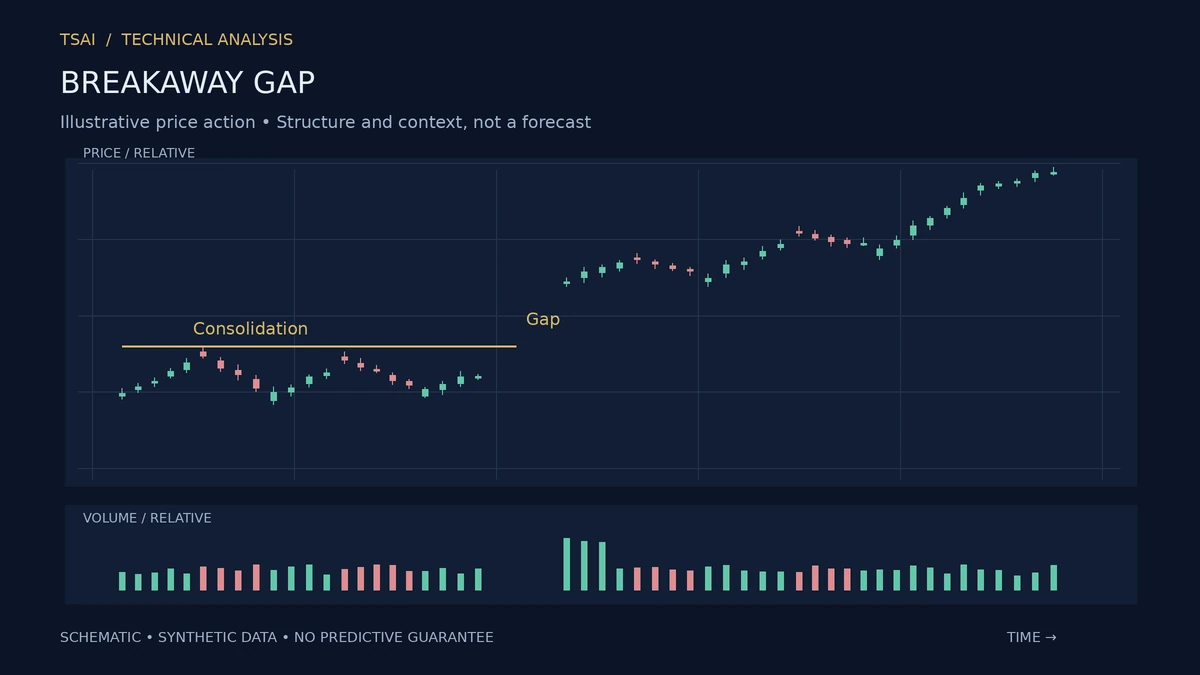
A breakaway gap occurs at the start of a trend, when price gaps out of a consolidation. The gap is accompanied by high volume, and it marks the beginning of a new directional move. Breakaway gaps are often not filled, because the move that created them is the start of a trend, not a correction.
Runaway Gaps
A runaway gap—also called a measuring gap—occurs in the middle of a trend. The gap is a continuation signal: the trend is strong enough to create a discontinuity. Runaway gaps are often used to estimate the length of the trend, because they tend to occur near the midpoint of the move.
Exhaustion Gaps
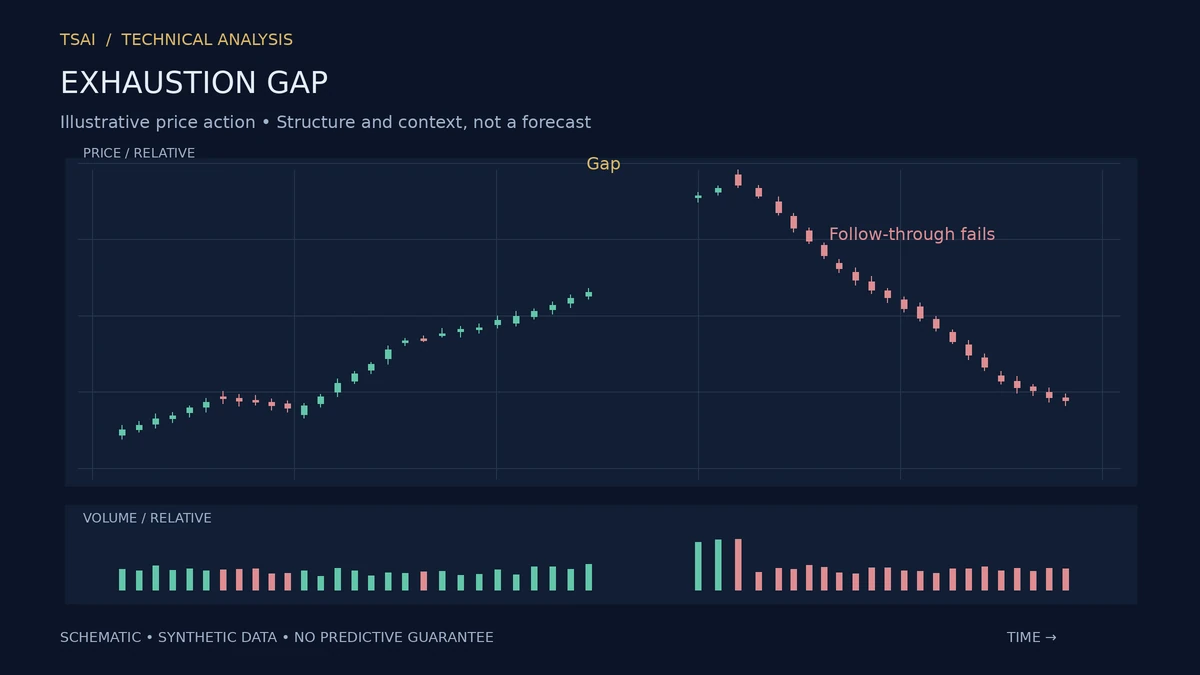
An exhaustion gap occurs at the end of a trend, when price gaps in the direction of the trend but the move is not sustained. The gap is often followed by a reversal. Exhaustion gaps are the most difficult to identify in real time, because the gap looks similar to a runaway gap until the follow-through fails.
Filling the Gap
The conventional wisdom is that gaps tend to be filled. The wisdom is partly true: common gaps are usually filled, and breakaway gaps are often not. The tendency depends on the type of gap, which is why the classification matters.
What Gaps Do Not Do
They do not predict price. They do not work because of any rule about empty space. They describe a discontinuity in the price series and make that discontinuity visible. Used with the classification and volume context, they are informative. Used as a mechanical signal, they will mislead.
Risk Disclosure: The above content is a discussion of technical analysis methods only and does not constitute any investment advice. Gaps carry no predictive guarantee; no single pattern should be the sole basis for trading decisions. Markets carry risk; decisions must be independent.